Generative AI: Campaign Visualization
Teams previously lacked a way to visualize and validate partnership ideas, slowing alignment and making decisions uncertain. This system transforms abstract partnership opportunities into tangible, AI-generated campaign concepts, providing a structured environment to explore alignment, generate creative direction, and evaluate partnership potential before execution.
Through this experience, users can:
Understand the strategic connection between brands and partners.
Generate campaign concepts and taglines using AI based on shared themes and positioning.
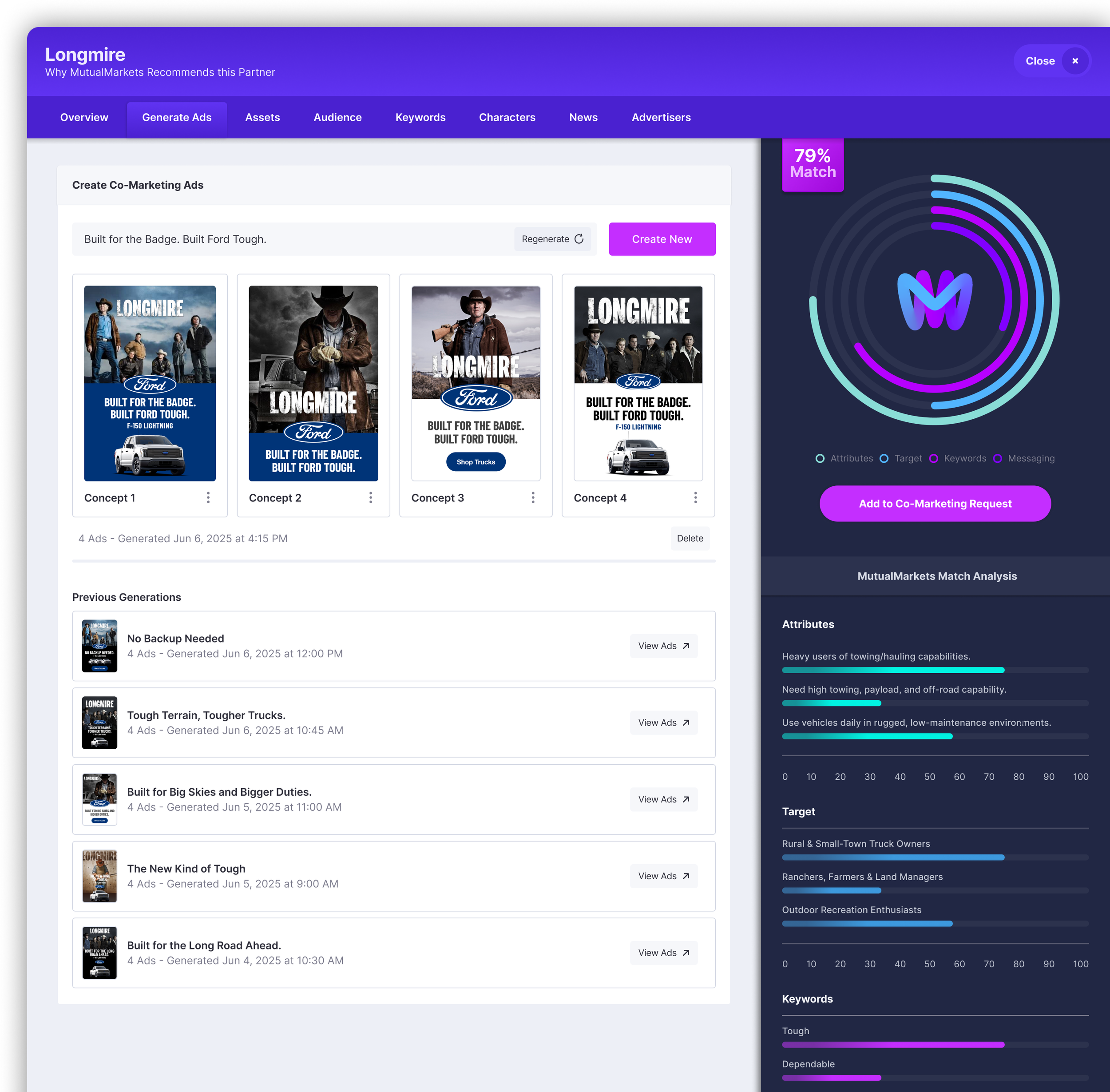
Visualize co-marketing campaigns through generated creative.
Apply brand-authored inputs to explore and refine custom directions.
Use AI-generated concepts to align stakeholders and support decision-making.
Role: Founding Product Designer and Director — defined UX strategy, platform architecture, and AI-driven workflows
Explore this Project in Figma
Interactive prototype demonstrating AI-generated campaign concepts and evaluation workflows.
From Recommendations to Campaign Concepts
A system that translates partnership recommendations into tangible creative direction.
It moves teams from insight to concepts they can evaluate, refine, and validate before execution.
Workflow
Creative evaluation system
→ Brand Analysis
→ Partner Discovery
→ Recommendations
→ Concept Generation
→ Iteration
→ Validation & Selection
The Problem: Strong Recommendations Without Validation
Partnership discovery was driven by predictive insights and strong recommendations, but teams had no way to translate those recommendations into tangible creative direction.
Without a way to visualize how a partnership could come to life, opportunities remained abstract. Teams struggled to assess quality, evaluate brand alignment, and build confidence in their decisions.
As a result, decision-making slowed, stakeholder alignment broke down, and promising opportunities were difficult to validate before moving into execution.
My Role
I designed the creative evaluation system that enables teams to turn partnership recommendations into tangible campaign concepts and make informed decisions before execution.
I defined the product architecture, core workflows, and interaction model that connect predictive matching to creative output. Recommendations are generated by evaluating each brand’s marketing, positioning, and audience, and when applicable, specific product context, then assessing potential partners to identify the strongest alignment.
From there, the system translates recommendations into creative direction. It generates a structured creative brief based on brand and campaign inputs, which serves as the foundation for tagline generation. Those taglines are then used to produce partnership ad concepts, making each opportunity visible and testable.
I designed the system to support a collaborative relationship between users and AI. The AI generates options, but users remain in control of direction, refinement, and final output. Generated taglines can be used directly, adapted, or replaced with custom inputs. Users can regenerate results, cancel generations, and remove outputs, ensuring flexibility and control throughout the process.
The system communicates clearly during generation and surfaces AI outputs as concrete, actionable representations of each opportunity. This makes it easier to assess quality, evaluate brand alignment, and compare directions while maintaining transparency into how outputs are produced.
By structuring concept generation, iteration, and refinement into a continuous workflow, the system enables teams to move from recommendation to validated direction with clarity and confidence.
How Ashley Evaluates Partnership Opportunities with AI-generated Creative
Ashley uses these tools to reduce uncertainty and move toward confident decisions:
Previews how a partnership could play out, reducing risk early.
Transforms abstract opportunities into tangible, testable concepts.
Enables early assessment of brand fit and alignment with Ford’s voice and audience.
Supports internal alignment with concrete examples that are easier to communicate.
Guides creative direction with strong starting points for focused collaboration.

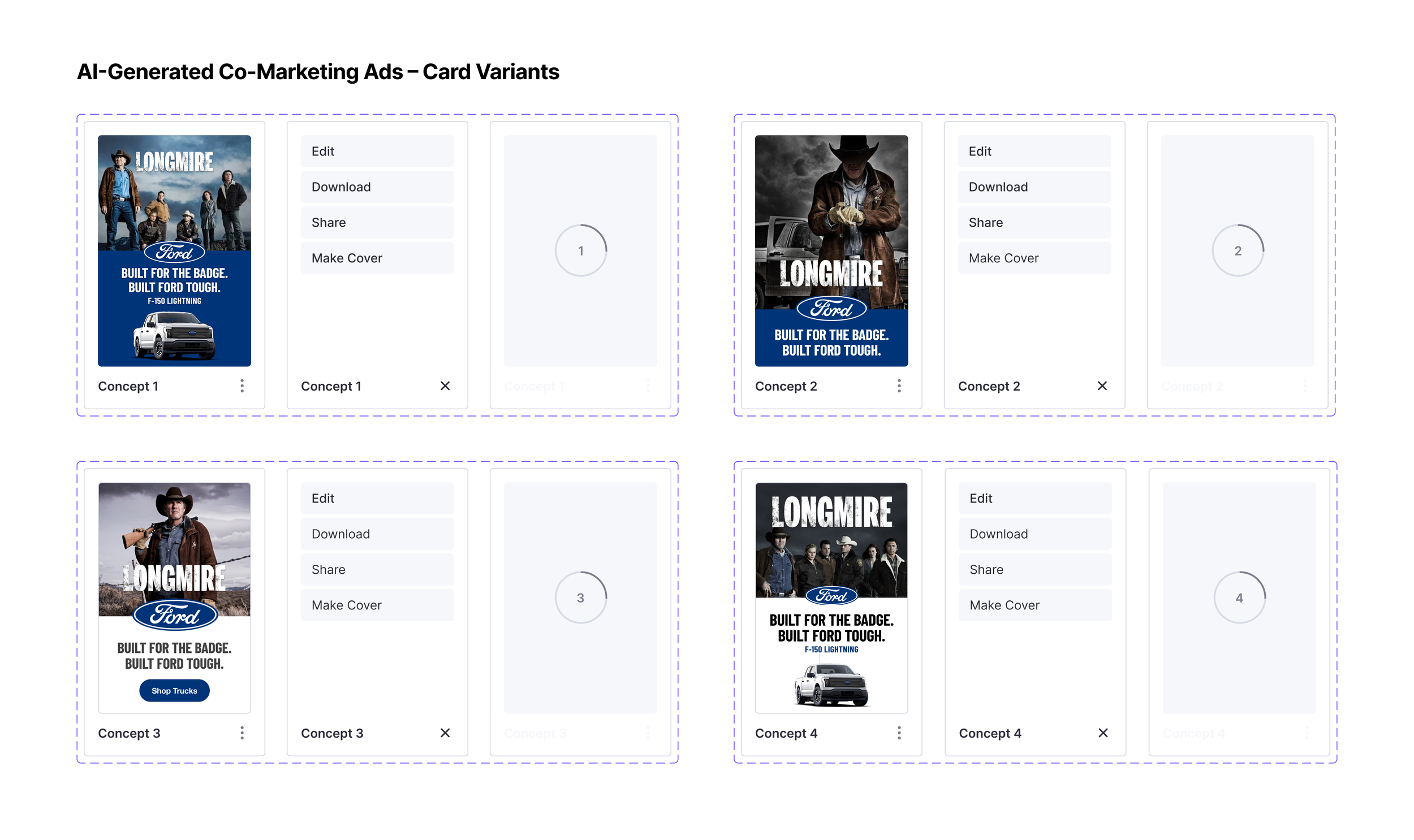
Design system components supporting a scalable platform.
Components support interactive prototypes, developer handoff, and consistent implementation across the platform. They are designed for reuse across workflows, enabling faster iteration and scalable implementation.