Predictive Systems: Identifying High-fit Partners
The partner discovery experience enables brands to identify, evaluate, and compare potential partners using predictive matching and explainable insights. It provides a structured environment for understanding strategic alignment, audience fit, and partnership potential, helping teams make confident, informed decisions.
Through this system, users such as Ashley at Ford can:
Discover partners recommended based on predictive alignment signals.
Understand why a partner is a strong match through explainable insights.
Evaluate audience alignment, performance indicators, and brand fit.
Compare multiple opportunities to identify the strongest partnerships.
Explore partnership potential before initiating outreach or negotiation.
Role: Founding Product Designer and Director — defined UX strategy, platform architecture, and core system workflows.
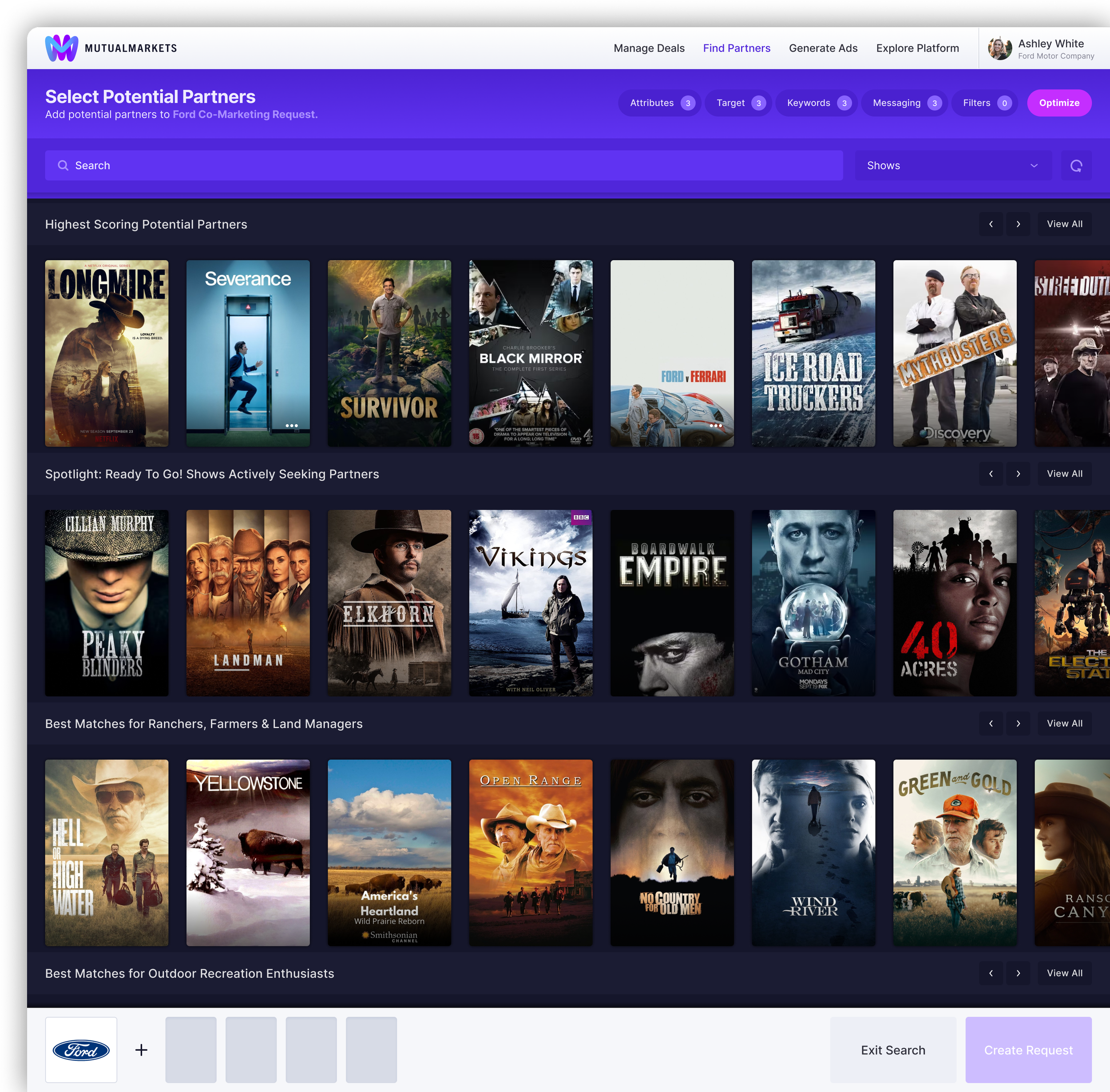
From discovery to confident selection.
A system for identifying and evaluating high-fit partners using predictive signals and structured comparison.
Each stage builds on the last, enabling teams to explore opportunities, assess alignment, and select the right partners with clarity and confidence.
Workflow
Partner evaluation workflow.
→ Discovery
→ Matching
→ Alignment
→ Insights
→ Evaluation
The Problem: No System for Partner Discovery and Evaluation
Before MutualMarkets, there was no system that allowed brands to discover and evaluate entertainment partners across TV shows and movies in a structured, data-driven way.
Partnerships were managed through relationships, industry knowledge, and manual outreach, making access limited and inconsistent. Brands could not browse available opportunities, assess alignment with their voice, values, audience, and products, or predict how a partnership would perform before committing to a deal.
As a result, identifying the right partners required significant time, guesswork, and coordination, making the process inaccessible for many brands and difficult to scale.
My Role
As the founding product designer, I designed the partner discovery and evaluation system that enables brands to access, analyze, and select entertainment partners based on alignment with their voice, values, audience, and products.
I defined the platform architecture and interaction model for structuring partner discovery around predictive signals and structured data. The system surfaces recommendations alongside the insights needed to evaluate fit, including audience alignment, brand compatibility, and performance indicators.
I designed workflows that allow brands to explore opportunities, compare potential partners, and understand why certain matches are recommended. By making these relationships explicit and transparent, the system enables more confident and informed decision-making.
This approach transforms a previously inaccessible, relationship-driven process into a scalable system where brands can identify and select high-fit partners with clarity and confidence.
Explore this project in Figma.
Each prototype includes a guided flow through the primary experience. Explore at your own pace. Prototypes open in a new window.
How Ashley identifies and selects the right partners
Ashley is responsible for identifying entertainment partners that align with her brand, audience, and campaign goals. The platform gives her access to a network of partners and surfaces recommendations based on fit.
Surfaces high-fit partners based on predictive signals.
Shows why a partner is a strong match, including audience and brand alignment.
Enables quick comparison to evaluate options and prioritize effectively.
Reduces reliance on manual research and industry relationships.

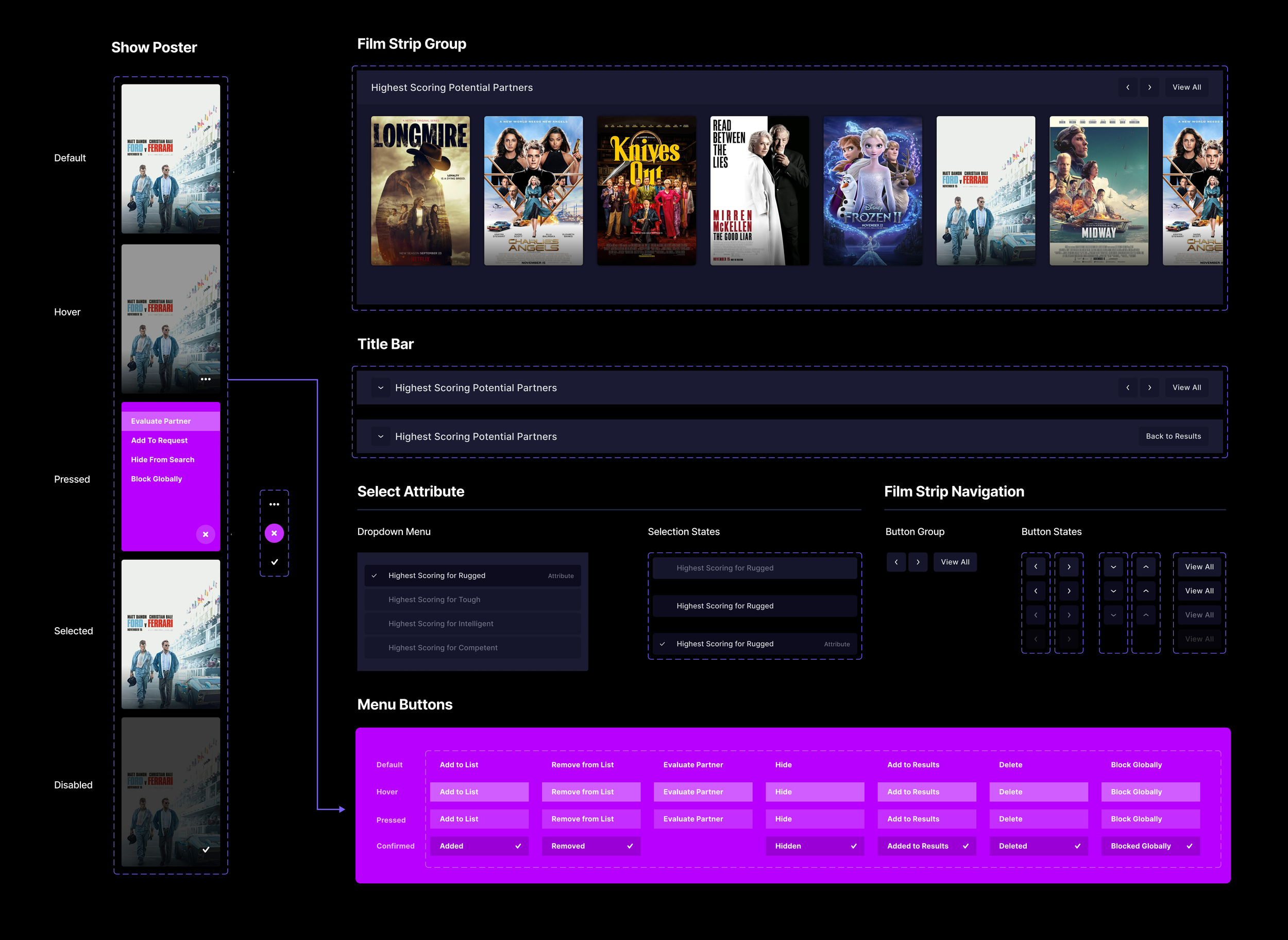
Design system components supporting a scalable platform.
These components support interactive prototypes, developer handoff, and consistent implementation across the platform. They are designed for reuse across workflows, enabling faster iteration and scalable implementation.