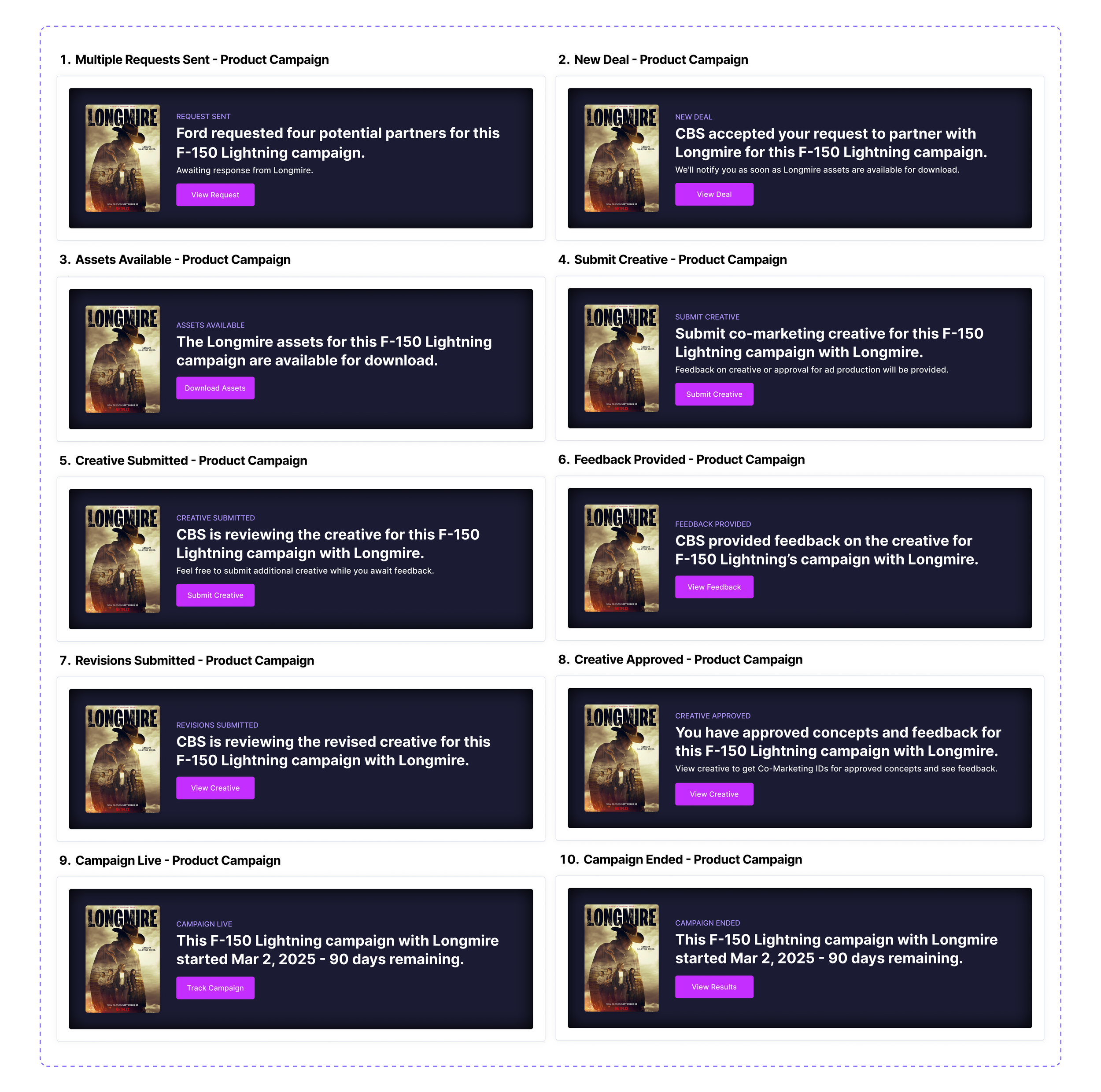
Architecting a single source of truth for partnership deals.
The MutualMarkets deal page serves as the operational foundation for partnership execution, providing a structured environment where stakeholders manage deliverables, approvals, and campaign workflows. It enables teams to coordinate across organizational boundaries, maintain shared visibility, and execute partnerships reliably within a scalable platform.
Through this environment, users—such as Ashley at Ford—can:
See the complete history of the deal, including every comment and task from initial request through campaign launch.
Track progress across key milestones, such as deal acceptance, asset sharing, creative submission, approvals, and live campaign performance.
Collaborate with entertainment partners in one shared workspace.
Access finalized deal terms, creative assets, and approved deliverables.
Invite additional contributors from either the brand or partner side to participate in the deal.
Jump directly to the deal page from dashboard notifications or status views, ensuring nothing is lost or delayed.
Role: Founding Product Designer — defined UX strategy, experience architecture, and platform workflows.

The problem.
MutualMarkets solved the critical challenge of partner discovery and validation—enabling brands and entertainment companies to identify and establish high-value co-marketing opportunities. However, once a partnership was initiated, there was no structured environment to manage execution across its full lifecycle.
Both brands and content owners needed a shared environment where they could participate in the deal, invite collaborators, track tasks, review activity, and manage approvals with full transparency. Every step—from the initial request through campaign launch and performance—required a coordinated system to ensure partnerships progressed efficiently and reliably.
Without this infrastructure, even validated partnerships remained operationally fragile, limiting the platform’s ability to support scalable, multi-party deal execution.
My role in solving the problem.
As the founding designer at MutualMarkets, I designed the deal page as the execution environment for managing the full lifecycle of partnership workflows. I defined the experience architecture, interaction model, and information structure needed to support coordinated execution between brands and content owners within a shared system.
I worked closely with founders and engineering to translate a complex, multi-step coordination process into a unified product experience—ensuring every stage of the deal lifecycle, from initial request through campaign launch and performance tracking, could be managed within a single environment.
This included designing workflows that enabled teams to:
Initiate and respond to partnership requests
Share and review creative assets
Submit and approve co-marketing materials
Invite internal and external stakeholders to participate
Track tasks, activity, and deal progression
Maintain shared visibility into campaign status and outcomes
I led design from concept through implementation, creating high-fidelity prototypes and defining system behavior to ensure the experience supported clarity, transparency, and scalability. The deal page became the operational core of partnership execution—accessible throughout the platform and serving as the central environment where stakeholders coordinated activity and advanced deals from initiation to completion.
Explore this project in Figma.
To make reviewing a large body of work easier, each prototype includes a guided pointer that walks you through the primary flow. Click to advance at your own pace. Prototypes open in a new window.
Why a single source of truth for every co-marketing deal matters to Ashley at Ford.
MutualMarkets centralizes every part of a co-marketing deal into one shared deal page—replacing scattered emails, documents, and tools with a clear, authoritative record Ashley can rely on.
Preserve the complete deal history, including comments, tasks, and decisions.
Provide a shared workspace for brands and partners after acceptance.
Surface milestone progress across approvals, assets, and launch.
Ensure deal terms, creative, and deliverables remain accessible and current.
Improve accountability by making ownership and status visible.
Allow stakeholders to join without disrupting the workflow.
Keep deals accessible through dashboard tasks and status views.

Example components used in this project.
These components support interactive prototypes, developer handoff, and are reused across multiple projects.